
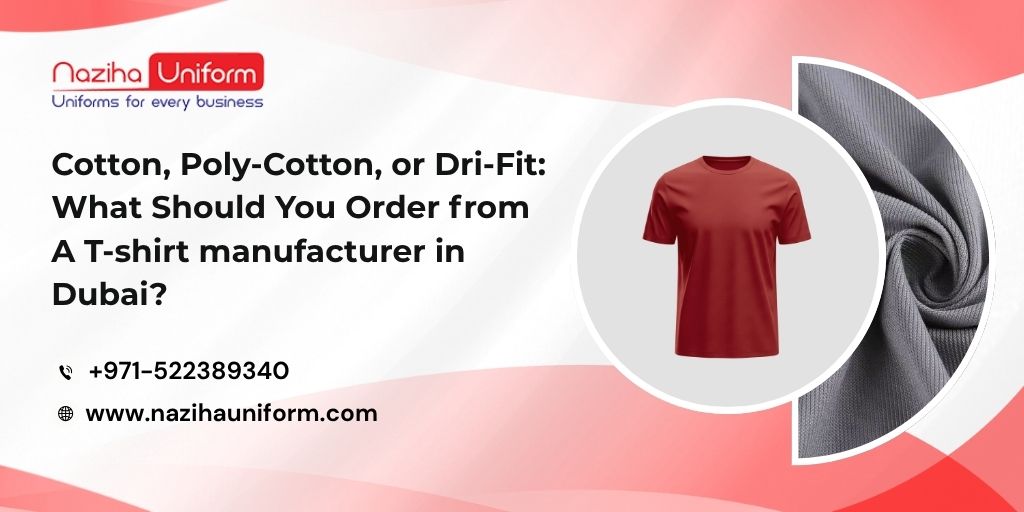
Order 100 percent cotton for premium indoor corporate wear, poly-cotton blends for daily-wear staff uniforms that need durability and easy care, and Dri-Fit polyester for outdoor teams, delivery fleets, and fitness staff working in Dubai heat. Each fabric solves a different business problem, and ordering the wrong one is the most common reason bulk t-shirt orders disappoint.
The choice matters because Dubai punishes fabric mistakes. Summer temperatures above 45 degrees Celsius, indoor air conditioning set to 22, daily washing, and constant perspiration expose every weakness a fabric has. A T-shirt that performs beautifully in a European office can look tired within a month on a Dubai warehouse floor.
As a working t-shirt manufacturing company in Dubai, businesses year-round, and we see the same fabric questions repeat across hotels, logistics firms, retailers, gyms, and event agencies. This guide answers them with the specifics a procurement decision actually needs: fibre behaviour, GSM weights, printing compatibility, and cost per month of service.
Why Does Fabric Choice Matter More in Dubai Than Anywhere Else?
Dubai combines three stresses that rarely occur together elsewhere: extreme outdoor heat, aggressive indoor cooling, and high wash frequency. Staff move between 45-degree loading bays and 22-degree interiors several times a shift, which means a single garment must manage sweat, dry quickly, and still look presentable to customers.
Fabric failure in this environment is visible and brand-damaging. Sweat patches on front-desk staff, shrunken collars after industrial washing, and faded colours on outdoor crews all trace back to one procurement decision made months earlier. Choosing fibre by use case, rather than by unit price, prevents all three.
When Is 100 Percent Cotton the Right Order?
Pure cotton remains the most breathable and comfortable fibre for indoor wear. It absorbs moisture, feels soft against skin, and carries the premium hand-feel that customer-facing brands want. For office teams, retail floors, boutique hospitality, and corporate gifting, 100 percent combed cotton at 180 GSM or above signals quality the moment someone touches it.
Cotton has honest weaknesses in this climate. It absorbs sweat rather than moving it away, so it shows patches and dries slowly. It shrinks 3 to 5 percent if not pre-shrunk, wrinkles easily, and fades faster under UV exposure. Any experienced cotton t-shirts manufacturer Dubai buyers work with should offer compacted or pre-shrunk fabric as standard, because that single processing step prevents the most common bulk-order complaint.
For branding, cotton pairs with screen printing and embroidery, not sublimation. If your design is a one-colour or two-colour logo on a premium tee, cotton with screen print or chest embroidery is the classic corporate combination.
When Does Poly-Cotton Win for Staff Uniforms?
Poly-cotton, typically a 65 percent polyester and 35 percent cotton blend, is the workhorse of staff uniforms. The polyester content adds tear strength, colour retention, and shape stability, while the cotton content keeps enough breathability for all-day wear. The blend dries faster than pure cotton and survives industrial laundering with far less shrinkage.
This is the fabric we recommend most often for cleaning companies, warehouses, facility management, and service teams whose shirts are washed three or more times a week. A poly-cotton tee typically outlasts a pure cotton equivalent by 40 to 60 percent in heavy rotation, which lowers the cost per month of service even when the invoice price is similar.
The trade-off is between feel and prestige. Poly-cotton reads as practical rather than premium, so it suits back-of-house and field roles better than executive or client-facing positions where fabric quality is part of the brand impression.
When Should You Choose Dri-Fit or Performance Polyester?
Dri-fit and similar performance polyesters are engineered to wick sweat to the fabric surface where it evaporates, keeping the wearer dry instead of soaked. For delivery riders, valet teams, outdoor maintenance, security posted outside, gyms, and corporate sports days, this is the only fabric category that genuinely works in Gulf summer conditions.
Performance polyester also unlocks the best branding method available. Because the fibre is polyester, Dri-Fit accepts dye sublimation, which bonds colour into the fabric permanently with no cracking, peeling, or added weight. Full-colour designs, gradients, and all-over branding cost no more than a single logo, and the print survives more than 50 industrial washes with over 95 percent colour retention.
The limitation is context. Polyester can hold odour longer than cotton without proper finishing, and its athletic look is wrong for formal front-of-house roles. Choose it for function-first teams, not boardrooms.
How Do GSM and Weave Change What You Actually Receive?
GSM, or grams per square metre, is the weight measure that separates a flimsy giveaway tee from a uniform-grade garment. As a rule of thumb for the UAE market: 140 to 160 GSM suits one-day promotional and event shirts, 180 GSM is the corporate standard for daily wear, and 200 to 220 GSM delivers the premium, structured feel for retail and hospitality brands.
Weave matters alongside weight. Single jersey is the standard soft t-shirt knit, while pique, the textured knit used on polos, hides sweat and wear better in service environments. Combed cotton yarns produce a smoother, longer-lasting surface than open-end (carded) yarns at the same GSM, which is why two 180 GSM shirts from different suppliers can feel completely different.
Always confirm GSM, yarn type, and shrinkage treatment in writing before production, and approve a physical sample. A reliable manufacturer offers this as standard practice rather than treating it as a special request.
Which Fabric Fits Your Industry and Budget?
Match the fibre to the job the shirt performs:
- Corporate offices and retail floors: 100 percent combed cotton, 180 to 200 GSM, embroidery or screen print
- Cleaning, logistics, warehouse, and field service: 65/35 poly-cotton, 180 GSM, screen-printed logos
- Delivery fleets, outdoor crews, and security: dri-fit polyester, 140 to 160 GSM, sublimated branding
- Gyms, sports events, and corporate wellness: dri-fit polyester with full sublimation, mixed sizes per team
- Exhibitions and one-day promotions: 140 to 160 GSM cotton or poly-cotton, single-colour screen print
Budget behaves differently across the three. Cotton costs more per premium piece, poly-cotton wins on lifetime cost for heavy rotation, and dri-fit with sublimation wins whenever the design uses more than three colours, because sublimation carries no per-colour charges.
The Right Fabric Is a Business Decision: Order It from People Who Manufacture It
Cotton buys comfort and prestige. Poly-cotton offers durability and easy care. Dri-fit buys performance in heat that ruins everything else. The correct order is rarely one fabric for the whole company; it is the right fabric for each team, specified by GSM, yarn, and printing method before production begins. Suppliers who cannot discuss those specifics are trading shirts, not manufacturing them.
That difference is exactly why businesses choose Naziha Uniform, the best t-shirt manufacturing company Dubai offers for custom corporate, promotional, and performance tees. We manufacture across all three fabric categories with premium cotton, poly-cotton, and dri-fit options, provide physical samples before bulk production, accept orders from any number of pieces with mixed sizes and colours, and deliver across every emirate within 7 to 14 working days.
Call +971-522389340 or email sales@nazihauniform.com today for a free consultation, and let us match the right fabric to every team you outfit.
Frequently Asked Questions
- What GSM is best for corporate t-shirts in the UAE?
180 GSM is the corporate standard for daily-wear t-shirts in the UAE. It is heavy enough to feel substantial and hold its shape through frequent washing, yet breathable enough for air-conditioned offices. Move up to 200 or 220 GSM for premium retail and hospitality brands, and down to 140 or 160 GSM only for one-day promotional shirts.
- Does 100 percent cotton shrink after washing in Dubai?
Untreated cotton shrinks 3 to 5 percent in its first hot washes, which is enough to change a fitted medium into a small. Ordering compacted or pre-shrunk cotton eliminates almost all of this movement. Confirm the shrinkage treatment in writing with your manufacturer and wash your approved sample before signing off on bulk production.
- Which fabric is best for logo printing: cotton, poly-cotton, or Dri-fit?
It depends on the branding method. Cotton and poly-cotton take screen printing and embroidery well, which suits simple one-colour to three-colour logos. Dri-fit polyester is the only option for dye sublimation, which produces permanent, full-colour, edge-to-edge designs at no extra cost per colour. Choose the fabric and printing method together, never separately.
- Is poly-cotton cooler than pure cotton in Dubai summer?
Not exactly. Pure cotton is more breathable, but it soaks up sweat and dries slowly, which feels heavy outdoors. Poly-cotton dries faster and stays lighter when damp, while Dri-fit actively wicks moisture away and is the coolest option for genuine outdoor work. For indoor air-conditioned roles, cotton remains the most comfortable choice.
- What is the minimum order quantity for custom t-shirts in Dubai?
MOQs vary widely by supplier, and many traders demand 100 pieces or more. At Naziha Uniform, custom t-shirt orders start at any number of pieces, with smaller trial runs possible depending on fabric and design. You can mix sizes and colours within a single order, and a sample is provided for approval before bulk production begins.
- How long does bulk t-shirt manufacturing take in Dubai?
A typical custom order is delivered within 7 to 14 working days after sample approval, depending on quantity and customisation. Local manufacturing avoids the 45- to 60-day shipping and customs timeline of overseas imports, which is why Dubai-based production suits event deadlines and fast uniform rollouts.