
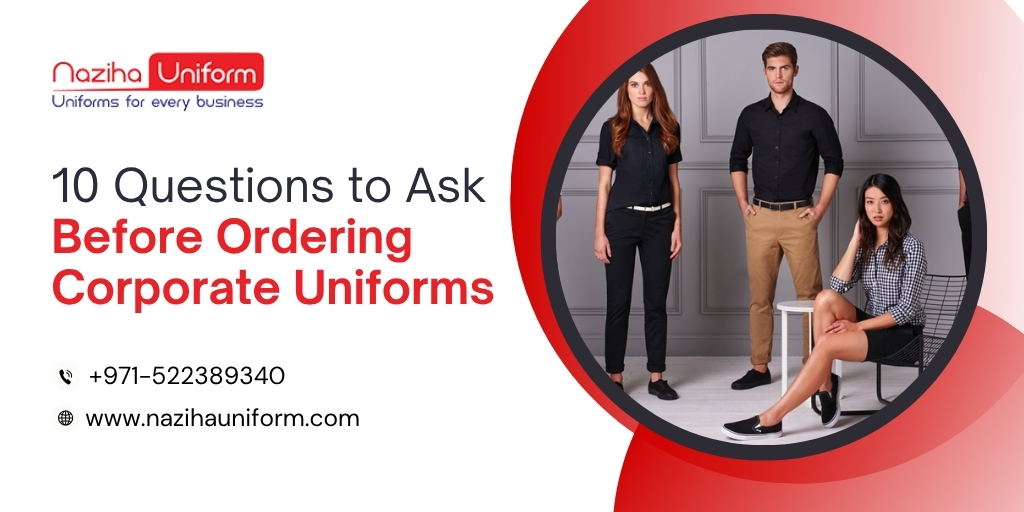
Choosing corporate uniforms is about more than selecting shirts, trousers, blazers, or branded workwear. The right uniforms should represent your company professionally, keep employees comfortable throughout the working day, and maintain a consistent brand image across your team. That is why choosing the right Corporate Uniform Supplier Dubai businesses can rely on requires more than comparing prices.
Before placing a bulk order, it is important to understand the supplier’s capabilities, materials, customization options, sizing process, production standards, and delivery timelines. A few well-planned questions can help you avoid inconsistent quality, poor fitting, unexpected costs, and delays.
If you are comparing suppliers in Dubai or elsewhere in the UAE, ask these 10 questions before making your final decision.
1. Can You Customize the Uniforms to Match Our Brand?
Corporate clothing is often one of the most visible representations of a company. Your uniforms should therefore reflect your brand rather than look like generic workwear.
Ask the supplier whether they can customize:
- Company colours and approved shades
- Logo placement and embroidery
- Employee names or job titles
- Shirt, trouser, blazer, or jacket styles
- Different designs for different departments
- Men’s and women’s cuts
- Special branding elements and accessories
Partnering with a capable Corporate Uniform Supplier in the UAE that businesses can trust should involve their ability to understand your brand guidelines and translate them into practical uniform designs, which builds confidence in their expertise and reliability.
Naziha Uniform, for example, provides custom corporate uniforms and offers branding through embroidery and printing. Its corporate collection includes office staff dress code, executive attire, receptionist clothing, and facility management uniforms.
2. What Fabrics Do You Recommend for Our Workplace?
Fabric affects comfort, appearance, durability, maintenance, and the overall cost of a uniform program.
Ask how the fabric will perform during everyday use to ensure it offers durability and comfort, helping you select uniforms that withstand Dubai’s climate and daily wear.
Consider asking:
- Is the fabric breathable and comfortable?
- Is it suitable for Dubai’s climate?
- Does it resist wrinkles?
- How well does it handle frequent washing?
- Will the colour remain consistent over time?
- Is the fabric suitable for indoor or outdoor work?
- Does the material require special maintenance?
The best choice depends on your employees’ roles. Office executives may need a refined suiting fabric, while employees who move around throughout the day may benefit from lighter and more flexible materials.
3. Can We See a Sample Before Bulk Production?
Never assume that the finished uniforms will look exactly like a digital design or catalogue photograph.
Request a physical sample before bulk production to reassure you about quality and to mitigate the risk of discovering major problems after large orders.
Check the sample for:
- Fabric quality and weight
- Stitching and finishing
- Colour accuracy
- Logo placement
- Embroidery quality
- Button and zipper quality
- Overall fit and comfort
- Appearance after basic movement
Naziha Uniform states that it offers samples for customers to review quality and design before full-scale production.
Getting approval on a sample can reduce the risk of discovering major problems after hundreds of garments have already been produced.
4. How Do You Handle Employee Sizing?
One uniform size does not work for every employee. Poor sizing can affect comfort, confidence, appearance, and employee satisfaction.
Ask your supplier how they will collect and manage measurements.
A professional supplier may provide:
- Standard size charts
- Individual measurements
- On-site fitting
- Men’s and women’s sizing
- Made-to-measure options where required
- Alteration support
- Size records for future orders
On-site fittings can be particularly useful for large organizations because employees can be measured consistently rather than relying entirely on self-reported sizes. Also ask how the supplier will handle new employees who join after the initial order.
5. What Is Your Minimum Order Quantity?
Minimum order quantity, or MOQ, can significantly affect your purchasing decision.
Some businesses need attire for hundreds of employees, while smaller companies may only need clothing for 10 or 20 team members.
Before requesting a final quotation, ask:
- What is your minimum order?
- Does the MOQ apply per design or to the entire order?
- Are different sizes included?
- Are different colours treated as separate orders?
- Can you support smaller replacement orders later?
The answer can help you determine whether the supplier is suitable for your current workforce and future growth.
6. What Is Included in the Quoted Price?
A low initial price does not always mean a lower overall cost.
Ask for a clear quotation that explains what is included. Depending on the supplier and project, additional costs could relate to customization, embroidery, special fabrics, alterations, packaging, delivery, or other requirements.
Your quotation should ideally clarify:
- Garment cost
- Custom design charges
- Logo embroidery or printing
- Sampling charges
- Measurement or fitting services
- Packaging
- Delivery
- Alterations
- Taxes or other applicable charges
A detailed quotation makes it easier to compare suppliers fairly instead of comparing only the price per shirt or garment.
7. What Is Your Production Timeline?
Corporate uniform orders often have deadlines connected to a new office opening, employee onboarding, rebranding, event, or company launch.
That makes production time an important part of your decision.
Ask:
- How long does design approval take?
- When will the sample be ready?
- How long does bulk production require?
- How soon can alterations be completed?
- What happens if the order is delayed?
- Can you handle urgent replacement requirements?
Naziha Uniform describes its process as consultation and requirement gathering, design and sampling, final production, followed by quality checking and packaging.
Understanding the complete process, including design approval, sampling, and production, will help you build a realistic purchasing schedule and meet your deadlines efficiently.
8. How Do You Maintain Consistent Quality on Repeat Orders?
This question is particularly important if you expect to reorder uniforms every few months or years.
Your first order may look excellent, but future orders should maintain the same colour, fabric, measurements, branding, and overall appearance.
Ask whether the supplier keeps records of:
- Approved designs
- Fabric specifications
- Colour references
- Logo artwork
- Embroidery details
- Patterns and sizing
- Previous order specifications
A consistent system makes it easier to provide uniforms to new employees without creating noticeable differences between old and new garments.
This is especially important for companies with large teams or multiple branches.
9. Do You Have Experience With Businesses Like Ours?
Different industries have different requirements.
A corporate office may prioritize formal appearance, while hospitality, retail, healthcare, security, or facility management businesses may have very different functional needs.
Ask the supplier whether they have experience producing dresscode for your type of workplace.
You can also ask for relevant examples of previous work, where appropriate.
Look for evidence that the supplier understands:
- Your employees’ daily responsibilities
- Expected level of formality
- Required durability
- Branding expectations
- Comfort requirements
- Department-specific designs
Naziha Uniform states that it supplies corporate clothing and workwear across the UAE and works with businesses including offices, banks, real estate firms, hospitality groups, and government entities.
10. What Happens After We Receive the Order?
The relationship with your supplier should not necessarily end when the uniforms are delivered.
Ask what support is available if you experience a sizing issue, defective garment, replacement requirement, or need to order additional uniforms later.
Important questions include:
- Do you provide replacement garments?
- Can employees request alterations?
- How are defective items handled?
- Can we reorder the same design later?
- Do you maintain our specifications?
- Is there a dedicated contact for future orders?
This is particularly valuable for growing companies where employee numbers change regularly.
Why Asking These Questions Matters
Corporate uniforms are a long-term investment in your company’s professional image. A good uniform program can create a consistent appearance across departments while helping employees feel like part of the same organization.
The benefits can include:
- Stronger brand recognition
- A more professional appearance
- Easier employee identification
- Greater consistency across locations
- Better team presentation
- Practical clothing designed for daily work
- Easier management of future uniform orders
The right supplier should therefore offer more than garments. They should be able to support design, customization, sizing, production, quality control, and future requirements.
How to Choose the Right Corporate Uniform Supplier in UAE
After asking these questions, compare suppliers based on the complete value they offer rather than choosing solely on the lowest quotation.
Pay attention to their:
- Experience and manufacturing capabilities
- Fabric and customization choices
- Sampling and fitting process
- Production capacity
- Quality control procedures
- Delivery commitments
- Communication and customer support
- Ability to manage repeat orders
A supplier that provides clear answers and a structured process is more likely to make your uniform project easier to manage.
Final Thoughts
Ordering corporate uniforms should be treated as a business decision, not simply a clothing purchase. The right garments need to combine professional presentation, employee comfort, practical performance, and consistent branding.
Before signing off on a bulk order, ask about customization, fabric, samples, sizing, minimum quantities, pricing, timelines, quality consistency, industry experience, and after-sales support.
If you are looking for a reliable Corporate Uniform Supplier Dubai businesses can work with for customized professional clothing, Naziha Uniform provides corporate uniform design, manufacturing, branding, sampling, and supply solutions across Dubai and the UAE.
Frequently Asked Questions
-
How early should I order corporate uniforms?
Ideally, begin the process early enough to allow time for consultation, design approval, sampling, sizing, production, quality checks, and delivery. Your supplier can provide a more accurate timeline based on order size and customization requirements.
-
Should every department have the same uniform?
Not necessarily. Companies can maintain consistent branding while using different designs for executives, reception teams, customer-facing staff, and support departments. The important thing is to maintain a recognizable visual identity.
-
Is embroidery better than printing for corporate uniforms?
The right option depends on the garment, branding requirements, and intended use. Embroidery can provide a polished appearance, while printing may be more suitable for certain designs and materials. Ask your supplier which method works best for your chosen fabric.
-
Can corporate uniforms be reordered when new employees join?
Yes, many uniform suppliers support repeat orders. When choosing a supplier, ask whether they retain your approved designs, sizing details, fabric specifications, and branding requirements for future production.
-
What should I send a uniform supplier before requesting a quotation?
Prepare your company logo, brand colours, estimated employee count, preferred styles, department requirements, size information if available, and required delivery date. This gives the supplier enough information to prepare a more accurate proposal.